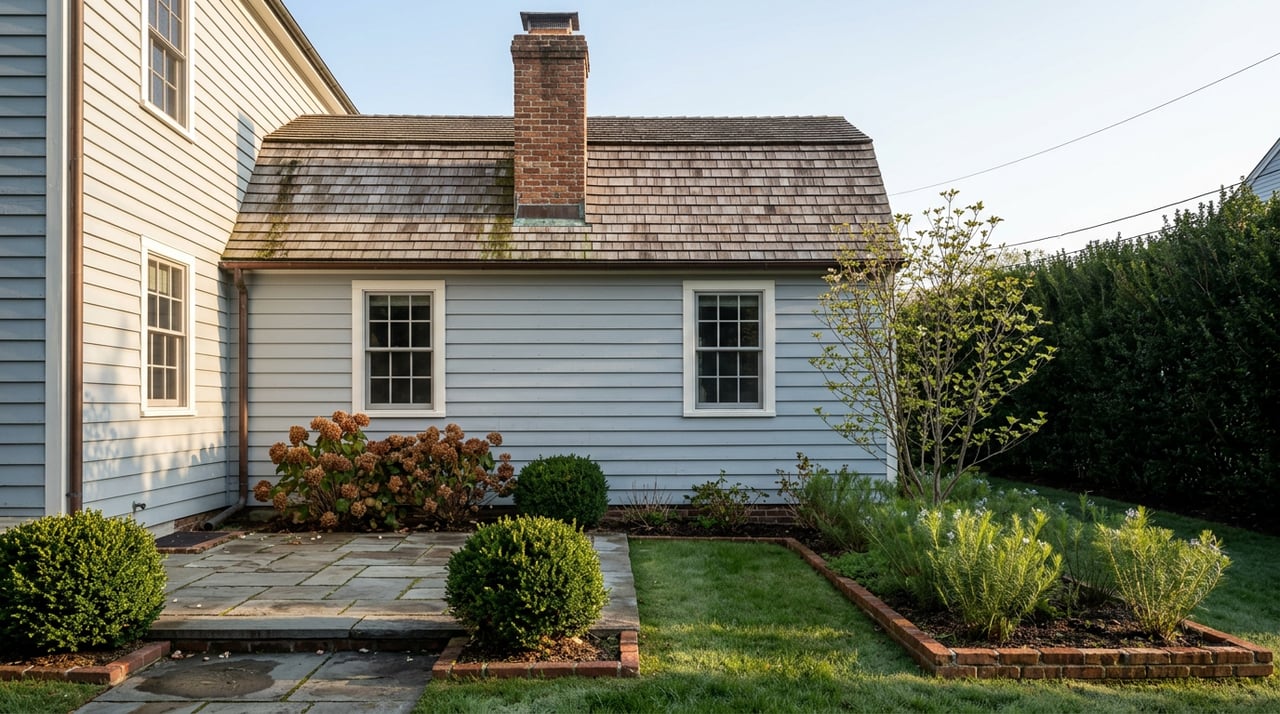
A couple in Newport's Point neighborhood wanted to build a modest three-bedroom, two-and-a-half-bath home on their waterfront lot on Washington Street. At roughly 3,400 square feet, the plan was smaller than several of the houses owned by the neighbors who opposed it. The project went through the Newport Historic District Commission. It went through the Zoning Board. It went through the Rhode Island Historical Preservation and Heritage Commission. It collected approvals from all three. Nearly five years later, according to reporting from Newport Buzz, the project remains in hearings, redesigns, and legal proceedings following appeals by neighboring owners.
For buyers, the commission's review is one part of the project timeline. The ordinance sets a deadline for the commission's decision, while appeals or other proceedings may add time after an approval.
The commission's review timeline
Newport's historic district ordinance does something buyers rarely expect from a preservation body: it puts a legal deadline on itself. Under the city's zoning code, the commission has 45 days from the date an application is filed to act on it. If the commission determines a project needs more study, it can take up to 90 days. If it misses even that window without a mutually agreed extension, the application is deemed approved by default.
That's not a loophole. It's written into the ordinance as a check on the commission's own power. A quorum of five commissioners has to be present, and at least four have to agree before any certificate of appropriateness is issued or denied. The process is procedural, dated, and bounded in a way that a lot of buyers assume historic preservation review isn't.
Not every exterior change triggers this review in the first place.
Examples from a commission meeting
The commission's February 10, 2026 meeting minutes document how applications were handled at that meeting. At that single meeting, an application from the Newport Restoration Foundation for a full exterior restoration at 32 Clarke Street, including clapboard repair, window restoration, and a roof replacement, was approved outright. An application at 27-31½ Franklin Street for a new dormer, a rebuilt bulkhead, and window replacement had its first part approved on the spot, with only a second component continued to the next month for more detail. A carriage house conversion at 6 Greenough Place was continued to the following month for further review.
None of these applications was denied at that meeting. Outcomes included approvals and continuances for further review.
Appeals and other proceedings after approval
The 88 Washington Street case illustrates how proceedings after approval can add time to a project. Government review has a deadline built into it. Once a project clears the Historic District Commission, the Zoning Board, and the state preservation commission, appeals or other proceedings may still add time.
For a buyer, this is the actual due diligence question worth asking before writing an offer on a historic property where you're planning meaningful exterior work: not "will the commission approve this," but "has this address, or this block, had a history of contested applications." A seller's disclosure won't tell you that. A title search won't either. It's the kind of thing you learn by asking the right questions of an agent who tracks these applications and, when it matters, brings in a contractor who has already sat in front of this specific commission.
Why some of the best addresses in the Point and the Hill aren't for sale at all
There's a second piece of friction that has nothing to do with approvals and everything to do with inventory. The Newport Restoration Foundation, founded by Doris Duke in 1968, owns more than 70 restored colonial houses concentrated in the Point and Hill neighborhoods. Those houses aren't listed for sale. They're leased long-term to tenant-stewards under an arrangement where residents commit to caring for the property in exchange for market-rate rent and NRF-provided maintenance.
That matters for anyone house-hunting in those two sub-districts specifically, because it means a real slice of the most architecturally significant housing stock in Newport simply never enters the resale market. If it feels like there's less to choose from in the Point than the number of historic houses would suggest, that's part of why.
The foundation's role in Newport's historic housing got fresh recognition in 2026. Its portfolio was named to the World Monuments Fund's Irreplaceable America list, announced June 30, 2026, alongside sites like Boston's African Meeting House and the Wright Brothers sites in Dayton. And at the 20th annual Doris Duke Historic Preservation Awards, set for a September 11, 2026 ceremony at Rough Point, the awards will recognize the restoration of Miramar, the 1912 Bellevue Avenue estate led by owners Stephen and Christine Schwarzman, and present a resiliency award to the Spouting Rock Beach Association for its flood-proofing of its 1939 clubhouse. Both projects point to where historic preservation in Newport is actually heading right now: not just matching old materials, but adapting historic structures to modern coastal conditions without losing their character.
Who reviews what
Buyers considering renovation work often lump every approval into one mental bucket labeled "historic district." In practice, up to three separate bodies can be involved, and they don't all review the same thing.
| Reviewing body | What it evaluates | Applies to |
|---|---|---|
| Newport Historic District Commission | Exterior appearance visible from public ways | Any property inside the local historic district |
| Newport Zoning Board | Setbacks, lot coverage, use, dimensional variances | Any property, historic or not, seeking a variance |
| RI Historical Preservation and Heritage Commission | Historic preservation matters | Projects involving historic preservation |
A project can need all three, one, or none, depending on the property and the scope of work.
What this means if you're already under contract
If you're buying a historic home in Newport with renovation plans, the practical move is to separate the two risks instead of treating them as one. Budget 45 to 90 days into any post-closing renovation timeline for the commission's own review, and don't assume that window will run long. Then, separately, ask your agent to check whether the specific address or block has any history of contested applications, appeals, or other disputes. That's a separate variable to investigate.
A few questions worth asking before you buy
Can I replace old windows with modern, energy-efficient ones? This is one of the more closely scrutinized categories. The Newport Restoration Foundation launched its own energy efficiency study in 2024 on a c.1730 house on Green Street specifically to find retrofits that improve performance without removing historic material, which tells you this is still an evolving area rather than a settled one.
What if the commission and my neighbors disagree about my project? Commission approval and neighbor consensus are separate considerations.
Buying or selling a historic property in Newport rewards the same thing every complicated transaction does: someone tracking the details before they become a problem, not after. Brian Jodoin works East Bay transactions this way, coordinating the contractors, timelines, and paperwork to help keep a historic-property transaction organized from the start. If you're weighing a purchase in Newport's historic district, start your home journey with a conversation about what your specific address actually requires.
This article is general information, not legal, tax or financial advice. Consult a qualified professional about your situation.
