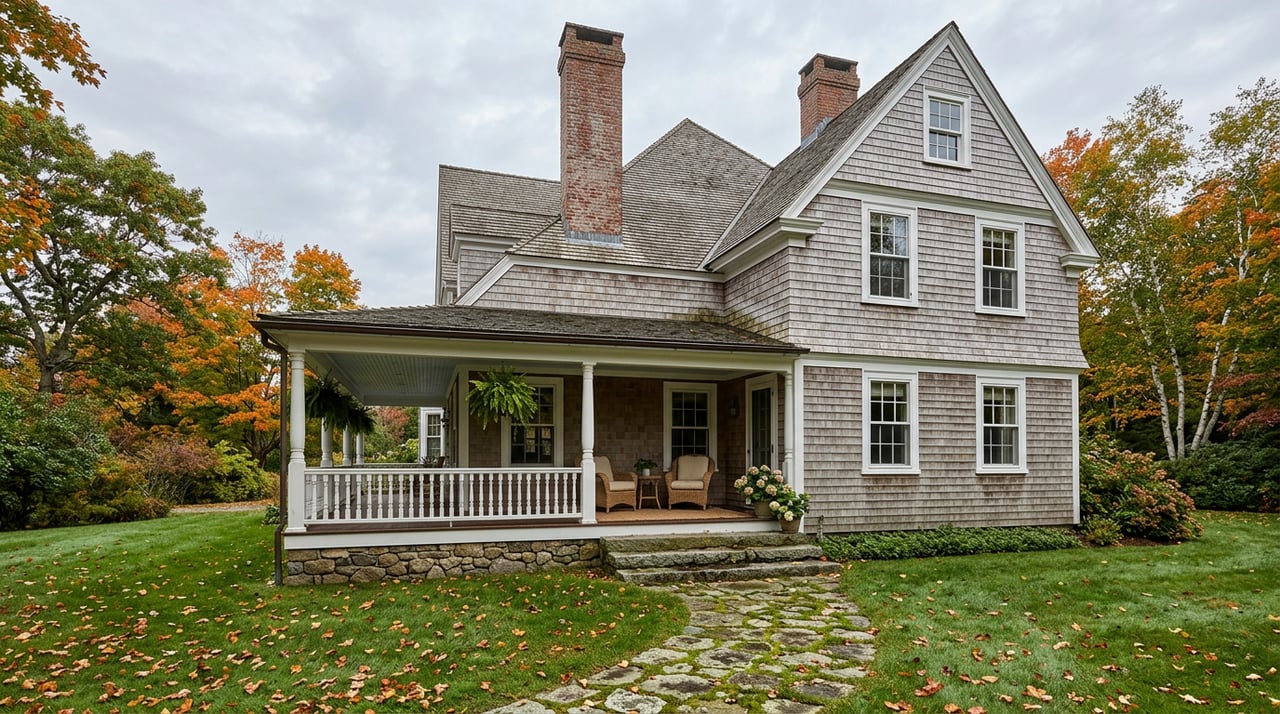
Swansea's fall doesn't feel like a season arriving. It feels like two stories picking back up where they left off, on opposite sides of town, at completely different speeds.
One is a hundred-year-old family farm doing exactly what it did last October, and the October before that, and probably the one before you were born. The other is a 65-year-old golf club that now has a new chef leading its kitchen in its second fall. Both are worth your Saturday. But they're not the same kind of worth, and knowing the difference changes how you spend the next six weeks.
What Doesn't Change at Simcock Farm
Simcock Farm on Marvel Street has been in the same family since the 1920s. James and Beverlyann Simcock run it now, the fourth generation to do so, and the barn behind the ice cream stand was built in 1932 and used to milk cows until 2005. That's not a detail added for charm. It's the reason the place feels unhurried even when the parking lot is full.
The rhythm repeats on schedule. The Sunflower Maze opens in late summer and by the time it fades, "Fall Fun on the Farm" is already starting, usually in late September, with pick-your-own pumpkins, hayrides out to the patch, and a corn maze that's been part of the property for years. The stand itself pours a lineup that runs 42 flavors deep, sourced from Warwick Ice Cream and Liebys Farm in Pennsylvania, alongside a menagerie of miniature cattle, miniature horses, donkeys, sheep, and goats that visitors can walk right up to. The signature move, though, is an evening event called Spooky Sundae, which has run for roughly a dozen years now and has become the kind of local tradition that doesn't need marketing because everyone already knows when it happens.
Down the road, Johnson's Roadside Farm Market fills the produce gap Simcock doesn't try to cover, a straightforward stop for what's actually in season rather than a destination event. Between the two, a Swansea fall Saturday can run entirely on farm stands without ever crossing into a grocery store.
None of this is new. That's the point. Simcock isn't trying to reinvent its fall. It's protecting one.
What Changed at Touisset Country Club
A few miles away, a much younger story is still being written. Touisset Country Club was built by hand, literally, over two years by Ray Brigham, who opened the golf course in 1961 with his wife Vilma as co-owner. Vilma also ran the kitchen. For decades, that kitchen didn't really have a public name of its own. It was just what happened at Touisset.
That changed in April 2025, when the club's dining room reopened under the name Vilma's, named for Vilma Brigham, who cooked there for years. Heading the kitchen now is Chef Nicholas Carreiro, who spent a recent winter refining his technique in Colorado and built his local reputation at Kent's before coming to Touisset. He's not trying to recreate a menu Vilma once cooked. He's building something new inside a space that's carried her name for one full season.
This fall marks Touisset's 65th anniversary, and Vilma's is only in its second year of existence. That's an unusual pairing: a club old enough to have three generations of family ownership behind it, serving a restaurant identity now entering its second season. If you ate at Vilma's last fall, you were one of its first regulars. If you haven't yet, you're not late. You're early in its story.
Two Timelines, the Same Six Weeks
Here's what's easy to miss if you only think of Swansea's fall as a checklist of open businesses: Simcock Farm and Vilma's are running on opposite kinds of time, and both timelines happen to peak in the same six weeks.
Simcock's fall is cyclical. It has already happened dozens of times, and the value of going this year is the value of ritual, the fact that the corn maze and the hayride and the Spooky Sundae are supposed to feel the same as last year. A hundred years of the same family running the same fields does that to a place.
Vilma's fall is linear. It has a start date and a second season, with Chef Carreiro bringing his own perspective to a room named for someone else. Going this year isn't ritual. It's a chance to see how Vilma's story continues to develop.
The Cole River runs through this same stretch of town, and it's worth knowing that the river most people think of as a quiet inland waterway actually turns tidal once it crosses under GAR Highway in Swansea, on its way from headwaters in Dighton through Rehoboth and into Mount Hope Bay. It's a small fact, but it says something true about the town itself: Swansea looks landlocked in the places you'd expect it to be inland, and it looks settled in the places you'd expect it to be new. The farm feels older than it should. The clubhouse feels newer than it is. The river under the highway is saltier than it looks.
Worth knowing before you plan the weekend: Simcock's pumpkin season and Vilma's dining room both run on their own internal calendars, not the town's. A golf club kitchen tends to wind down with its course as the weather turns, while a farm's hayride season tends to hold through Halloween. If you want both this year, don't save either for the last weekend of the season.
A Short List for the Next Six Weekends
- Pumpkins and hayrides: Simcock Farm's Fall Fun on the Farm, running from late September through the Halloween stretch, PYO pumpkins and corn maze included.
- Produce without the event: Johnson's Roadside Farm Market, for the week you just need vegetables.
- A meal: Vilma's at Touisset Country Club, in its second fall under Chef Nicholas Carreiro, inside a clubhouse marking 65 years.
- Brunch with a local sourcing habit: Black Salt on Wilbur Avenue, which draws from local farmers' markets for its seasonal rotation.
- A short walk to close the day: the stretch of the Cole River near GAR Highway, where the water is already tidal even though it started as a stream in Dighton.
Why This Contrast Is Worth Noticing
A town's character often shows up in what it protects and what it's willing to let someone new define. Swansea is doing both at once this fall. Simcock Farm is proof that four generations can run the same tradition and have it still feel necessary. Vilma's shows how a 65-year-old institution can add a new chapter to its story.
Neither story is finished. That's what makes this particular fall worth paying attention to, whether you've lived here for decades or just found the corn maze for the first time.
Brian Jodoin has spent his life in this part of the East Bay, watching towns like Swansea hold onto their oldest traditions while making room for new ones. If a season like this one ever turns into a conversation about buying or selling here, reach out to Brian Jodoin whenever you're ready.
