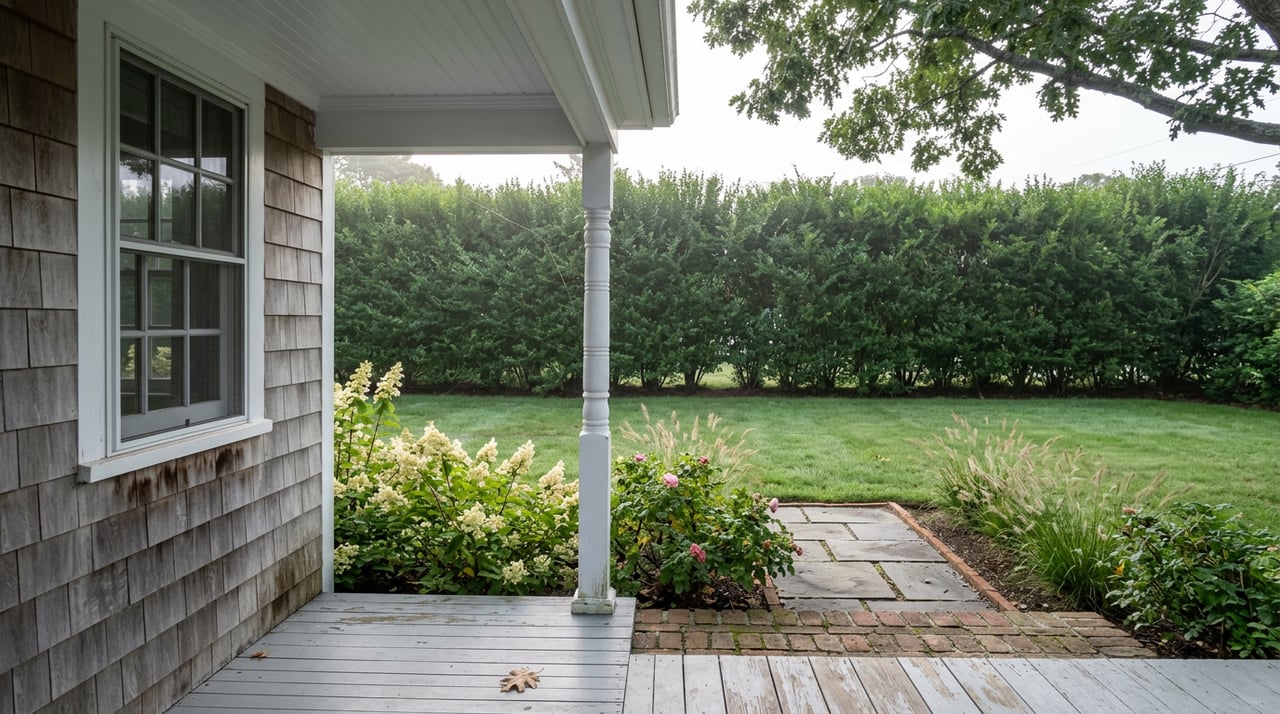
In June, a two-bedroom cottage on Pokanoket Trail in Warren's Touisset neighborhood sold for $1.9 million. It sits on two-thirds of an acre along the Kickemuit River, with a private dock long enough to reach deep water and a view that runs west toward Bristol. According to Providence Business News, it was the highest residential sale in Warren since July 2005 and the second-highest in the town's history. Residential Properties Ltd. represented the buyer, with sales associate Dory Skemp handling the transaction.
Here's the number that matters more than the sale price. The town's own assessor's database lists that same property at $800,400 for 2025, broken out as $496,200 for the land, $291,600 for the building, and $12,600 for the outbuildings. A house that just changed hands for $1.9 million carries an official town assessment that isn't even within a million dollars of what it sold for.
That gap is the fact worth sitting with if you own a second home in Warren, or if you're deciding whether now is the time to sell one. Rhode Island's new Non-Owner-Occupied Property Tax, informally called the "Taylor Swift Tax," took effect July 1, 2026, and it decides who owes based on assessed value, not sale price. Everyone writing about this law has covered the headline rate. Almost nobody has looked at what happens when a town's assessment lags its own market by more than a million dollars, which is exactly what just happened on Pokanoket Trail.
How the tax actually triggers
The Rhode Island Division of Taxation applies the tax to residential property assessed above $1 million that is not the owner's primary residence. A property clears the bar for "non-owner occupied" if the owner doesn't live there for a majority of the year, and it stays exempt only if it's rented for 183 days or more under a lease covered by Rhode Island's Residential Landlord and Tenant Act. Casual or seasonal rental activity that falls short of that threshold doesn't qualify.
The rate is $2.50 for every $500, or fraction of $500, of assessed value above the $1 million line. Paid in quarterly installments due each September 15, December 15, March 15, and June 15, it works out like this:
| Assessed Value | Amount Over $1M | Annual Tax |
|---|---|---|
| $1,200,000 | $200,000 | $1,000 |
| $1,500,000 | $500,000 | $2,500 |
| $2,000,000 | $1,000,000 | $5,000 |
| $3,000,000 | $2,000,000 | $10,000 |
The first payment under this new law comes due September 15, roughly three weeks from now.
Assessed value, not sale price, is what counts
For this first tax year, the Division of Taxation is using each property's assessed value as of December 31, 2024. That detail matters more in a town like Warren than it does in a market where high-value sales happen routinely, because it locks in a number that predates recent price movement, and towns don't reassess every year. Depending on where a municipality sits in its revaluation cycle, the figure on file can run years behind what a property would actually fetch on the open market.
Pokanoket Trail shows exactly how far behind that number can sit. Whoever bought that house this year now owns a property worth $1.9 million by every measure a buyer, seller, or appraiser would use, sitting on an assessment of $800,400. Under the mechanics of this tax, that owner isn't close to the $1 million trigger this year, regardless of what they paid at closing. A future revaluation could change that. Nothing about the sale itself does.
Why the gap matters more in a town this size
Statewide, the median single-family home sale price was $525,000 in July 2026, up from $505,000 a year earlier, according to the Rhode Island Association of Realtors. Warren's own housing stock sits well within that range for most of the year. A $1.9 million closing isn't a routine data point here. It's news, the kind that gets its own headline in the regional business press.
That scarcity is the second half of the story. Warren's last comparable benchmark was 15 Read Avenue, a five-bedroom Colonial on 3.2 acres along the Kickemuit River that sold for $1.2 million in 2024, the highest sale in town that year according to EastBayRI.com. Before that, the record-holder was a 2017 sale on Stonegate Road in Touisset that closed at $1.6 million, reported at the time by Patch. Three sales, spanning nine years, define the top of Warren's market.
When a town sees a seven-figure sale every few years instead of every few months, its assessor's models get tested against true market value far less often at the top end than they do closer to the median. That's not a flaw specific to Warren. It's what happens when a small coastal town has a handful of high-value waterfront parcels and a normal pace of turnover everywhere else. The practical result is that owners of Warren's priciest homes may have more room before this tax applies than a quick look at their sale price would suggest, and less warning once a revaluation does catch up.
What to check before you assume either way
- Pull your own assessment card from the Warren tax assessor's office and check the effective date of the last full revaluation, not just the current number.
- Track your actual occupancy. If you or a tenant under a Rhode Island Residential Landlord and Tenant Act lease is in the property fewer than 183 days a year, the exemption doesn't apply, and the Division of Taxation expects documentation such as utility bills, lease agreements, and tax filings, not a verbal account.
- Don't substitute a broker's opinion of value, a comparable sale, or an online estimate for your assessed value. Only the number on file with the town counts for this specific tax.
- If you have an open appeal on your assessment, know that you still owe based on the current assessed value until the appeal is resolved, with a refund process available afterward if the appeal succeeds.
- Watch your mail. Statewide, the Division of Taxation sent a determination questionnaire to more than 9,000 property owners this year to sort primary residences from non-owner-occupied ones, a process detailed in a Rhode Island Association of Realtors member alert.
What this means if you're selling
The tax follows the owner, not the property, which changes how it factors into a sale. A current owner who has paid it for a full year has a real annual carrying cost to weigh against the decision to sell. A buyer stepping into a purchase with an under-assessed property, the way the new owner of 5 Pokanoket Trail effectively has, may face no liability at all this year despite paying well above the seven-figure mark, right up until Warren's next revaluation catches the sale price. That timing gap is worth naming plainly on both sides of a transaction. Sellers marketing a high-value Warren property should be ready to speak to the current assessment as part of the total cost picture a buyer will weigh. Buyers should ask when Warren last completed a full revaluation, not only what today's assessment happens to say.
None of this is tax or legal advice, and the specifics of any individual situation, especially anything involving an appeal, a partial-year rental, or a recent purchase, deserve a conversation with a Rhode Island tax professional or a direct read of the Division of Taxation's published guidance.
A few questions worth asking early
Does this apply to a multi-family or investment property in Warren? The tax targets residential property that isn't rented under a qualifying lease for 183 days or more. A small multi-family that's actually occupied by tenants under Rhode Island's landlord-tenant law for most of the year is unlikely to trigger it, regardless of assessed value, as long as that rental activity is documented.
What if I rent my property short-term through a platform like Airbnb for part of the year? The exemption requires 183 days or more of rental under a lease subject to the Residential Landlord and Tenant Act. Occasional short-term bookings don't automatically add up to that threshold unless the documented rental days clear it.
How do I know for sure whether I owe? Start with your own assessment card and the Division of Taxation's published FAQ. If your situation involves an appeal, a recent sale, or mixed personal and rental use, that's the point to bring in a tax professional rather than rely on general guidance.
If you own, or are weighing whether to buy or sell, a second home along Warren's waterfront, Brian Jodoin can walk through what your specific assessment card actually says today, how it compares to recent sales in Touisset and along the Kickemuit River, and what a future revaluation could mean before you make a decision based on someone else's tax bill. Start your home journey when you're ready to talk it through.
