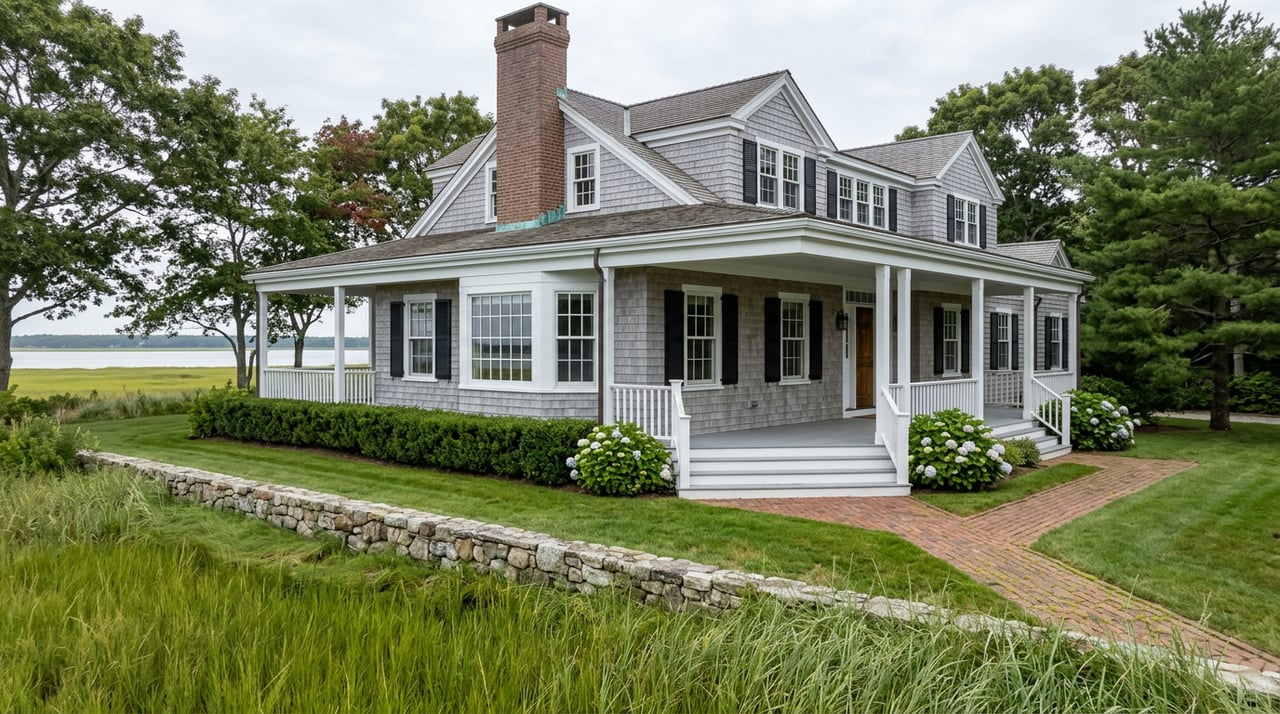
Drive out along Seaview Avenue toward the water and there is no fence, no sign, no change in the pavement to mark where Massachusetts ends and Rhode Island begins. The marsh grass looks the same on both sides. The Kickemuit River doesn't stop to check passports before it empties into Mount Hope Bay. Yet somewhere in that quiet stretch of Touisset, a line drawn nearly three centuries ago still decides which government taxes your roof, on what schedule, and how fast your assessment catches up to what the house actually sold for.
Touisset is one of the more unusual addresses in the East Bay because it exists twice: once as a neighborhood in Swansea, Massachusetts, and once as Touisset and Touisset Highlands across the line in Warren, Rhode Island, near the Touisset Marsh Wildlife Refuge and the Touisset Point Community Club. Buyers comparing a listing on the Swansea side to one on the Warren side are often comparing more than square footage and water frontage. They're comparing two states that run their property tax assessments on completely different clocks, and that difference shows up on the closing statement whether anyone points it out or not.
Where Rhode Island Ends and Massachusetts Picks Up
Warren sits on the southwest border of Swansea, with the Cole, Kickemuit, and Palmer rivers threading through both towns on their way to Mount Hope Bay. The peninsula that carries the Touisset name straddles that border directly. On the Warren side, Touisset and Touisset Highlands are described as a quiet, waterfront neighborhood of larger lots near the marsh refuge. On the Swansea side, the same name shows up on listings along Seaview Avenue, a short distance up the same shoreline.
For a buyer touring both, the physical experience barely changes. The tax experience does. And the reason has nothing to do with which town spends more or values homes more aggressively. It has to do with a scheduling rule written into each state's tax code.
Two States, Two Different Clocks
Massachusetts requires every city and town to certify property values on a triennial cycle, and in the two years between certifications, assessors are required to complete an annual analysis and adjust values if the market has moved. That interim-year adjustment is the mechanism that keeps a Massachusetts assessment reasonably close to current market value every single year, not just once every three.
Rhode Island runs on a longer clock. Under state law, cities and towns perform a statistical update in the third and sixth years of a cycle, using desk-based market analysis rather than a physical inspection, and a full revaluation with in-person inspections in the ninth year. Between those mandated touchpoints, a Rhode Island assessment can sit unchanged for years even as the market underneath it moves.
The practical result is that Massachusetts assessments tend to creep upward in small annual steps, while Rhode Island assessments can stay flat for years and then jump all at once when the nine-year clock comes due.
| Swansea, MA | Warren, RI | |
|---|---|---|
| Assessment update rule | Annual interim-year adjustments between triennial certifications | Statistical update at years 3 and 6, full revaluation at year 9 (R.I. Gen. Laws § 44-5-11.6) |
| Most recent value reset | FY2026 values updated using 147 single-family sales through December 31, 2025, producing a $500,000 median sale price | Full revaluation with the assessment date of December 31, 2025 |
| Approximate median effective tax rate | About 1.19% | About 1.44% |
| Approximate median annual tax bill | About $5,100 | About $5,570 |
Why Warren's Number Just Jumped
Warren's most recent full revaluation carries a December 31, 2025 assessment date, which means every property in town, including whichever homes sit on the Touisset peninsula, was just re-inspected and reset to catch up with however many years of appreciation had built up since the prior full cycle. That is the nature of a nine-year system: the correction doesn't happen gradually, it happens all at once, on schedule, whether the local market moved a little or a lot in the meantime.
Swansea's most recent number tells a different kind of story. The town's FY2026 figures come from an annual market check, 147 sales analyzed through the end of 2025, landing on a $500,000 median sale price. That's not a revaluation event. It's the ordinary yearly recalibration Massachusetts law expects every town to run, which is why Swansea's assessed values rarely require a dramatic one-time jump.
If you're comparing a home on each side of the peninsula this year, you're not just comparing two towns. You're comparing a Massachusetts assessment that has been tracking the market annually for years against a Rhode Island assessment that just absorbed however much appreciation had piled up since its last full inspection. Two houses that sold for the same price last year can carry very different-looking tax histories going into this year, purely because of where each state sits on its own clock.
The Rate Gap Doesn't Go Away
Here's the part that surprises people who assume Rhode Island's lower price tags automatically translate into a cheaper carrying cost. Even after Warren's fresh revaluation, its median effective property tax rate runs close to 1.44%, compared to roughly 1.19% in Swansea. Warren's median annual tax bill lands around $5,570, ahead of Swansea's roughly $5,100, even though a plain read of listing prices on the Rhode Island side often looks like the better deal on paper.
Run that against a specific number. On a $500,000 house, a 1.19% effective rate works out to about $5,950 a year. The same $500,000 house taxed at 1.44% comes to roughly $7,200 a year, a gap of more than $1,200 annually that has nothing to do with school quality, lot size, or water access. It is purely a function of which state's revenue formula applies to that particular parcel.
That gap is worth knowing before you fall in love with a lower asking price on one side of the peninsula. The sticker price and the carrying cost are two separate calculations, and on this stretch of the East Bay, they don't always point in the same direction.
What Else Ignores the Line
Property tax is the clearest example, but it's not the only place where the state line quietly changes the math on an otherwise identical piece of waterfront.
Sewer and septic infrastructure follow town boundaries, not market logic. Homes closer to a village center are more likely to be on public sewer, while outer peninsula lots on either side of the line are more likely to rely on private septic systems, which means a different inspection scope and a different repair budget conversation during due diligence.
Flood and wind insurance quotes are worth getting early rather than late on any home this close to Mount Hope Bay, since premiums on peninsula and marsh-adjacent property are often the largest line item buyers underestimate, regardless of which state issues the deed.
Buying Into a Cycle, Not Just a Town
The honest takeaway for anyone comparing Touisset listings on the Swansea side against the Warren side isn't that one town is cheaper and the other isn't. It's that you're buying into two different assessment calendars, and the number on this year's tax bill tells you less about the house than it does about where each town happens to sit in its own multi-year cycle. A Rhode Island assessment that looks low this spring might be six years overdue for a correction. A Massachusetts assessment that looks steady might already reflect last year's market in full. Knowing which clock you're buying into is the kind of detail that belongs in your offer strategy, not just your closing paperwork.
A few questions worth asking before you write an offer
How recently was this specific town's assessment updated, and where is it in its cycle? Ask the listing agent or check the town assessor's site directly. A property assessed right after a full revaluation carries less near-term risk of a sudden jump than one that's five or six years into a nine-year Rhode Island cycle.
Is the home on public sewer or private septic? This matters more on peninsula and outer-village lots on both sides of the line, and it changes your inspection scope.
Have you gotten an actual flood and wind insurance quote, not an estimate? On water-adjacent property this close to Mount Hope Bay, the real number often differs meaningfully from what a rate calculator assumes.
Comparing towns across a state line takes more than a spreadsheet of medians. If you're weighing a Touisset address on either side of that line, or anywhere else in the East Bay where Massachusetts and Rhode Island rules overlap, Brian Jodoin can walk you through what each town's assessment cycle actually means for your specific offer. Start your home journey today.
